
The typical cable delay compensation value to be used for the portable Quad Constellation Multi-band antenna offered by VeEX is 26 ns (VeEX P/N: Z99-99-033G).
- Coaxial Type: RG-174
- Cable Length: 5 m
- Velocity of Propagation: 66% or 5.05 ns/m
- Theoretical Delay: 25.25 ns
However, the actual delay may vary between production batches, so the actual cable delay value of the antenna should be verified following a quick procedure using a TDR with direct time-of-flight reading, such as the CX41 Coaxial TDR (no conversions, estimates or approximations required). Note that other portable GNSS antennas come with different coax cable lengths (e.g., 3m, 4m, 5m) as well as any added cable extensions. Once you have the measured cable delay, use a label maker to document it next to the connector.
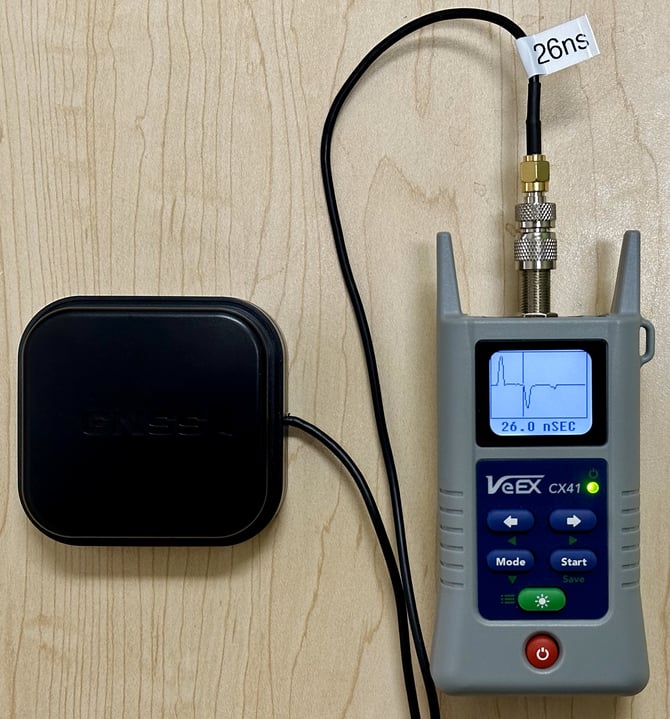
Tip: For Precision Timing applications, test and measurement in particular, it is recommended to measure and label all test cables and antenna cables with their intrinsic physical delays.
This multi-band GNSS portable active antenna supports the 1.2 GHz and 1.6 GHz bands, with a high LNA gain of 38 dB, supporting GPS L1C/A and L2C, GLONASS L1OF and L2OF, Galileo E1B/C and E5B, BeiDou/BDS B1 and B2I.
A multi-band GNSS Receiver card (optional P/N: Z99-99-034P) is required, to take advantage of the multi-band antenna, when used for High Precision timing applications. Supports tracking of up to eight concurrent satellite signals, including the GPS (L1C/A, L2C), Galileo (E1B/C, E5B), GLONASS (L1OF, L2OF), and BeiDou/BDS (B1I, B2I) bands.
What If You Don't Have a Proper Coax TDR?
The next best thing one could do to get the best estimate is:
-
Measure the cable length, read the coaxial cable's markings, find its datasheet online and use its typical Velocity of Propagation to calculate the approximate delay. For example, a 3 m cable with VP = 66% of the speed of light (5.051 ns/m or 1.539 ns/ft) should be approximated to 15 ns.
-
However, the estimate for longer cables may introduce more approximation error, and some cables may not be properly marked.
-
Also, you won't be able to manually measure the length of cables that are already inside a duct.
Glossary
GNSS - Global Navigation Satellite Systems (generic for USA GPS, Russia's GLONASS, Europe's Galileo and China's BeiDou)
LNA - Low Noise Amplifier
TDR - Time Domain Reflectometer
VP - Velocity of Propagation (in ns/m or ns/ft)
VP% - Velocity of Propagation as a percentage of the speed of light.
Related Test Solutions
- RXT-1200 - Advanced Modular Test Platform
- TX340s - Advanced Multi-Service Test Set
- MTTplus - Modular Test Platform
- CX41 - Coaxial Time Domain Reflectometer (TDR)