
High‑level Positioning
Looking at them at a very superficial level, we could summarize it as:
- MPA (MPA Series / 1RU platform)
A compact, modular multi‑protocol analyzer optimized for 1G–400G testing in labs, production, and interoperability environments where power density and rack space matter. 
- MPA‑HD (High Density platform)
A high‑power, high‑port‑density system designed specifically for 800G and future high‑power optics, enabling simultaneous multi‑user, multi‑port testing at scale. 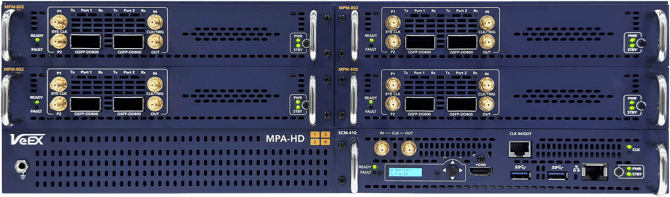
Key Differences at a Glance
|
Area |
MPA |
MPA‑HD |
|
Primary use case |
General R&D, SVT, manufacturing, interoperability |
High‑density 800G R&D, SVT, manufacturing |
|
Max data rates |
1G up to 400G |
800G (and beyond‑ready) |
|
Chassis size |
1RU rack‑mount |
3RU rack‑mount or benchtop |
|
Module capacity |
Up to 6 standard MPA modules (depending on chassis gen) |
Up to 4 high‑power HD modules |
|
Port density focus |
Flexible, mixed‑rate testing |
Extreme port density (e.g., multiple 800G ports) |
|
Power & cooling |
Low‑power, standard cooling |
High‑power (>3.5kW capable), front‑to‑back cooling |
|
Optics support |
CFP2, CFP8, QSFP28/56/DD (module‑dependent) |
QSFP‑DD800, OSFP800, high‑power ZR/OpenZR+ |
|
Target environment |
Space‑efficient labs, production lines |
Large labs, data‑center and NEM validation |
|
Software & control |
HTML5 Web UI, Python API, SCPI CLI |
Same UI, Python API, SCPI CLI (script‑compatible) |
Chassis and Hardware Architectures
MPA
- 1RU compact chassis, optimized for dense rack deployments
- Supports multiple generations of standard MPA test modules (Ethernet, OTN, FC, SONET/SDH)
- Designed for lower power consumption and 24×7 operation
- Ideal when you need flexibility across protocols rather than raw port count
MPA‑HD
- 3RU high‑density chassis built specifically for high‑powered 800G optics
- Supports up to 4x MPM‑HD‑802 or MPM‑HD‑822 modules
- Dual, pluggable AC power supplies with load‑sharing and redundancy
- Engineered cooling for >30W coherent ZR/OpenZR+ plugs
Port Density and Performance
- MPA focuses on multi‑protocol flexibility: Ethernet/IP, OTN, Fibre Channel, SONET/SDH from 1G–400G, with many different module types available.
- MPA‑HD focuses on maximum Ethernet density, enabling configurations such as 8×800G test ports per chassis depending on module and breakout mode.
Software, Automation, and Workflows (same strengths)
Both platforms intentionally share the same control and automation model:
- Common HTML5 Web UI
- Python API and SCPI CLI
- Script compatibility between MPA and MPA‑HD platforms
- Multi‑user operation with independent port control
These key advantages allow teams to reuse automation and test scripts when transitioning from MPA to MPA‑HD.
When to Choose Which
Choose MPA if you need:
- A compact 1U system
- Broad multi‑protocol coverage (Ethernet, OTN, FC, SDH/SONET)
- Testing up to 400G
- Lower power and smaller footprint
Choose MPA‑HD if you need:
-
800G and next‑generation Ethernet testing
-
Very high port density
-
Support for high‑power coherent optics
-
A platform optimized for large‑scale lab and manufacturing environments
Contact us to discuss your test environment's needs and requirements, so we can provide more in-depth information about the extensive feature set available in these two products.