
Ghost Reflections, or "echoes", in Optical Time Domain Reflectometers' (OTDR) traces are often misunderstood and misdiagnosed. These reflections are "false" events that may appear on an OTDR trace, under certain conditions, even though no actual connector, splice, break, impairment or reflective interface exists at the indicated distance. Those reflective events are often displayed outside of the physical fiber (beyond the end of fiber). These "fake" reflections are created by test pulses bouncing back and forth between two highly reflective events.
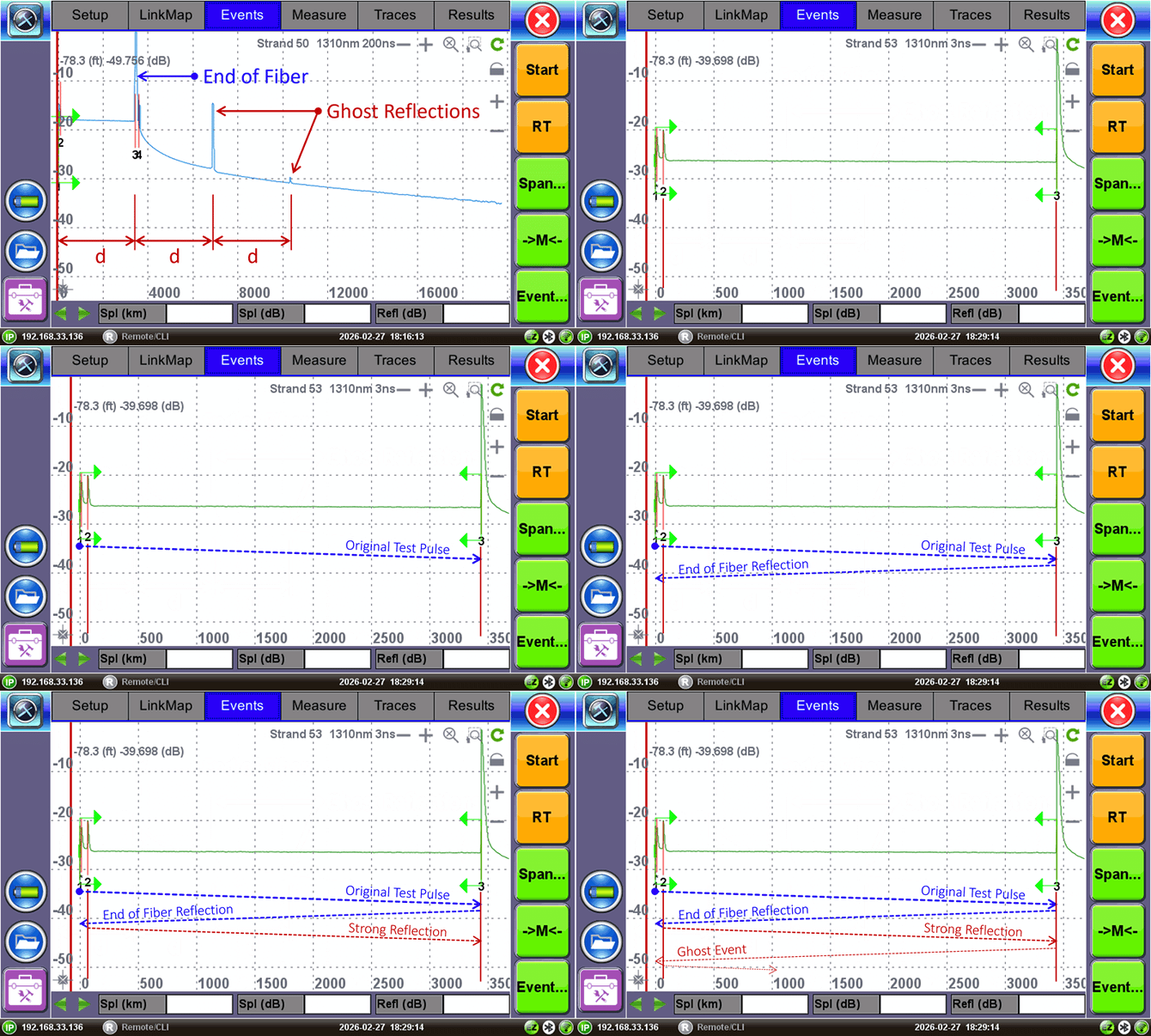
In certain cases, the instruments' advanced (smart) trace analysis may not flag them as wrong, so it requires awareness, knowledge and experience to identify and remove these anomalies, when they occur. Understanding and correctly identifying Ghost Events and their root cause is crucial because:
-
They can be mistaken for real connectors or breaks at the wrong location and you may waste time trying to troubleshoot it there.
-
They can lead to incorrect alarming, diagnosis, unnecessary truck rolls to the wrong site and increased operational cost.
-
They may confuse automated event analysis in PON and long-haul links.
Ghost reflections that appear beyond the physical end of the fiber are generally easier to recognize and are often correctly detected and handled by smart link map analysis software and events table. However, they may only be visible on the trace when you zoom out to a longer analysis span. While the test set is functioning properly in these situations, less experienced users may still be confused by what they see on the trace. The example below illustrates such a case.
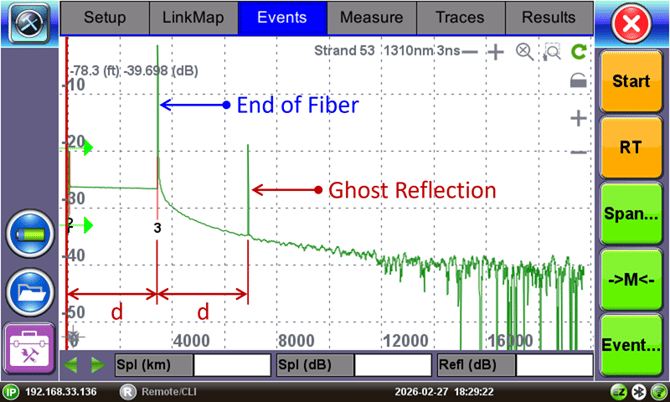
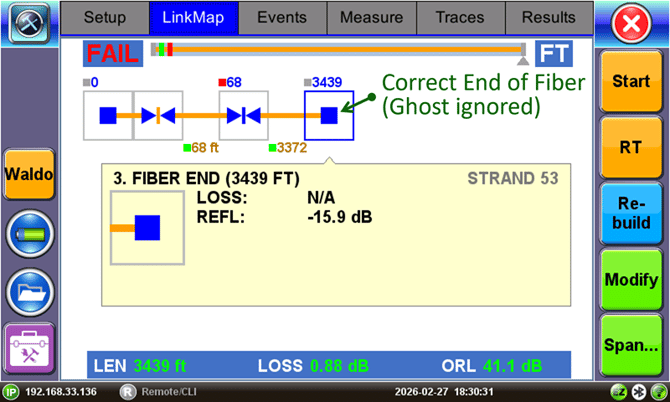
Although the link map summary generated by the OTDR’s smart analysis correctly identifies all link elements and the fiber end, the presence of a ghost reflection in the trace still indicates a problem—either with the link itself (strong internal reflection) or with the measurement setup (test configuration or connections). In the example above, the result is flagged as a FAIL, and the red square mark above the event icon indicates that you must inspect the connection at 68 ft (20.7 m). In this example, even though you don't see the ghost in the link map view, you can see that there is a problem, which is the root cause for the ghost to appear.
How to Identify Ghost Reflections
These ghost events are generated by multiple reflections of a significant Fresnel event, such as a dirty or damaged connector, connector mismatch, air gaps, poorly aligned mechanical splices, bad fusion splices and an open fiber end. These reflections re-enter the fiber under test, bounce back, and are detected again by the OTDR.
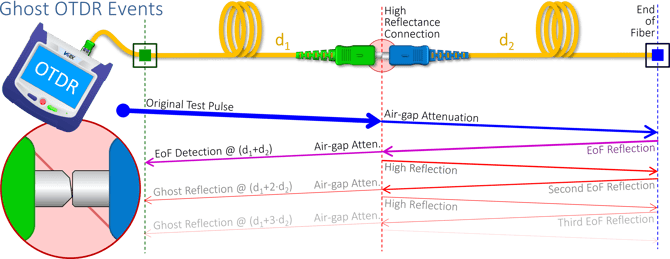
A frequent cause of ghost reflections is poor OTDR connectivity, typically from dirty, damaged, or mismatched connectors. In these situations, because the test leads (including launch reels) are much shorter (d1) than the fiber under test (d2), any resulting ghost events appear on the trace beyond the End of Fiber (EOF). They show up at distances that are approximately integer multiples of the total fiber length (2·d2, 3·d2, etc.).
Ghost reflections on an OTDR trace may be identifiable by some of their specific characteristics:
-
They follow a strong reflective event. Ghost reflections occur when a connection has very high reflectance, generally worse than -40 dB and more typically when reflectance exceeds about -30 dB.
-
They occur at distances mathematically related to earlier reflections (often multiples of the fiber length between strong reflections). This gives you a hint on where to zoom in to start searching for the root cause.
-
They show a reflection but no corresponding loss.
-
They may not change after the fiber under test is physically inspected.
- They tend to occur more often when testing short fibers.
Challenges
When present, accurate identification of ghost reflections is critical for reliable fiber certification and maintenance, yet it can be difficult and not always straightforward. Even the smart link map analysis in modern test sets can be misled by these events, and correctly interpreting the results still requires technician experience.
- If there is only one highly reflective event caused by test-related connections, the corresponding ghost reflection would appear after the end of fiber, at approximately twice the distance from the OTDR port, which may make them easier to identify. However, when multiple highly reflective events are present within the fiber link, the situation becomes more complex, and a ghost reflection may appear at approximately twice the distance from the preceding highly reflective event.
- Ghost reflections that occur within the fiber span may be identified because exhibit no associated loss. However, ghost reflections that appear beyond the physical end of the fiber may display measurable loss, particularly when they are located on the trailing edge of the end reflection.
- Ghost reflections that appear outside of the fiber span may not be displayed on the selected or automated range view of the OTDR display, so users may not be aware of (or see) them unless they zoom out on purpose.
- In certain cases, ghost events may be less apparent when using a larger pulse width because the higher overall signal level increases backscatter, which can obscure or mask the ghost reflection.
Can Ghost Reflections Be Removed?
Yes. However, the focus shall be on identifying and eliminating the highly reflective events that caused the ghost in the first place. Ghost events are often created by (bad) temporary connections made for testing purposes. A properly executed OTDR test report should not contain ghost reflections, except when they are being specifically documented as the fault under investigation. Once identified, ghost reflections shall be eliminated by addressing the root cause.
-
 Some articles may recommend terminating the far end of the fiber to reduce or eliminate the strong EOF reflection and make the ghost disappear. While this may indeed suppress the visible ghost, it does not address the real problem. The underlying high‑reflection fault remains in the link under test, so the issue is not actually resolved.
 -
Thoroughly clean and inspect all connectors. (Eliminate highly reflective connections, such as damaged or dirty connectors, APC to UPC connector mismatch, etc.).
-
Use APC connectors where possible.
-
Use of proper launch and receive fibers (launch cables), for further troubleshooting.
-
Use the OTDR trace and analysis to identify high reflectance connections or splices within the fiber span and get them fixed.
-
Have a good idea of the expected link characteristics, so you can detect anything that seems out of place.
-
If the separation between ghost events is a multiple of your launch cable length, then inspect all the connections, because one of them may be highly reflective.
-
Reduce pulse width if dynamic range allows. This will only reduce the total energy put into the link, so the ghosts are no longer visible. However, the high reflectance issue(s) that caused the ghost will still need to be addressed.)
-
Use proper fiber termination during testing. That is, avoid testing into open fiber ends. (Note: Terminating the far end of the fiber during testing can hide ghost events because it eliminates the large reflection from an open fiber end, leaving little or no optical power to bounce back and forth and generate those ghosts. However, the high reflection fault that caused ghosts in the first place will still be there.)
Why is it Important to Eliminate (the Cause of) Ghost Reflections?
Because ghost events are caused by high reflectance points in the fiber link—typically seen as large, sharp peaks on an OTDR trace—they introduce high return loss into data links. This leads to signal degradation, reduced performance, increased error rates, and potential system failures, especially in high-speed, high‑power transmission systems. High‑power single‑mode lasers are particularly vulnerable and some could be damaged by excessive back‑reflection.
Note from the author: Some online articles may claim or imply that ghost events are not a significant issue and suggest they can be minimized or even disregarded. In reality, since ghost events are caused by highly reflective connections or impairments, they represent a serious problem that must be corrected. In practical terms, the presence of ghost reflections should always be treated as an indication of an underlying fault.