
A gain, or “gainer,” event on an OTDR trace appears as a positive bump that resembles “negative loss", if such a concept could even exist. Since passive fibers cannot amplify light, this behavior can be confusing or counterintuitive, particularly for less experienced fiber technicians and OTDR users. Although some articles may describe gainers as “false” readings, they are actual events that, when properly interpreted, provide useful diagnostic information.
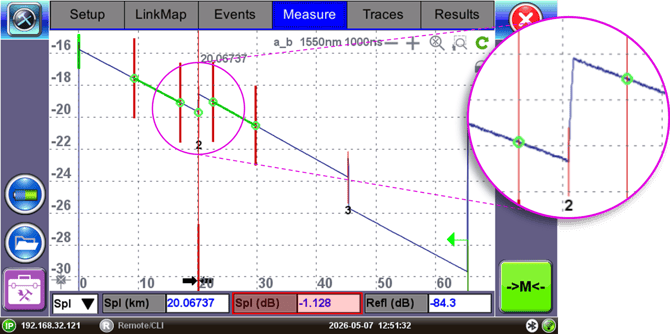
Figure 1 - Gainer example measured using the 4-point Splice Loss method.
Gainer events are moderately common in modern fiber optic testing, particularly when using traditional single-direction OTDR testing. Occasionally, an OTDR trace may show a gain event, while not a true increase in optical power, a gainer appears on a trace as a power step-up at a splice or connector point, often caused by connecting fiber sections with different backscatter coefficients, such as splicing G.652 (standard) and G.657 (bend-insensitive) fibers.
Bend-insensitive fibers (BIF) are specifically engineered to reduce attenuation under tight bending conditions. It incorporates a low refractive index trench around the core that helps confine and guide the light. Compared to standard single-mode fiber, BIF can sustain significantly smaller bend radius (down to approximately 7.5 mm), making it well suited for high‑density installations, FTTH deployments, and data center environments.
In practical terms, fiber optic gainer events appears when two fibers with different backscatter coefficients are spliced or connected, and the OTDR test pulses transition from a fiber with lower backscatter to one with higher backscatter. This situation is typically associated with Mode Field Diameter (MFD) mismatches, for example when standard SMF-28 is joined to bend-insensitive fiber, or when 50 µm and 62.5 µm multimode fibers (MMF) are interconnected.
Does disimilar fiber splicing happen often in modern fiber networks?
That depends on the age of the fiber plant, service provider, fiber operator or data center. Commonly cited examples are fiber-to-the-home (FTTH) and fiber-to-the-premises (FTTP) networks, where standard bend-sensitive fibers are typically deployed for the outside plant because the routes are well engineered and this is the most cost-effective option, while higher-cost bend-insensitive fibers are often reserved for indoor segments to accommodate the unpredictability of less controlled in-home installation conditions, in which challenging fiber routing decisions are made on-the-fly.
Main Causes of Gainers in OTDR Traces

Figure 2 - Simplified core diameter mismatch splice illustration.
-
Core Diameter Mismatch: Mismatching fiber core sizes, particularly connecting 50µm to 62.5µm fiber, creates a large gainer. Connecting Single mode 8 µm to 10 µm will also result in a small gain signature.
-
Dissimilar Fibers: When a fiber has a lower backscatter coefficient than the fiber it is connected or spliced to, the OTDR sees a sudden increase in backscattered light at the junction, interpreting it as a "gain" rather than a loss.
-
MFD Mismatch: Splicing different types of single-mode fiber, specifically standard fiber to bend-insensitive fiber, causes significant backscatter differences.
-
Reflective Events: A highly reflective connection followed closely by a 2nd event can sometimes cause an event gain in the trace, misconstrued as a gainer. This is due to inadequate distance between events resulting in the recovery tail after the reflection not having enough length to fully recover to normal scatter.
Practical Implications
We already know that fiber optic cables cannot amplify light on their own, so the gain measurement value alone doesn't help. However, if we look at the reverse direction, by shooting the OTDR from the opposite end (if possible and practical), the same event will show a high loss, equal or greater than the "gain" value previously measured.
How to Measure the Actual Event Loss: In order to obtain the actual loss at the event in question, we have to take OTDR measurements from both ends of the fiber link and calculate the bidirectional average.
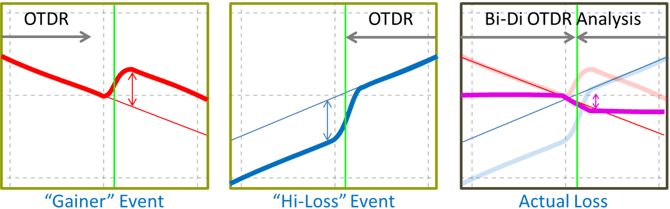
Figure 3 - Simplified bidirectional OTDR loss calculation illustration.
Some OTDRs, like VeEX's FX160 FiberBEAST™, work in pairs to provide fully automated bidirectional testing and perform these calculations internally. In addition, certain OTDRs, along with cloud-based and PC analysis software, support post‑processing of both traces (one from each direction) to carry out the bidirectional “X” analysis. The screenshot below shows the bidirectional OTDR traces, with event 2 shown as a "gainer" in the A-to-B direction and as a high-loss event in the B-to-A direction, with the actual loss being the average.
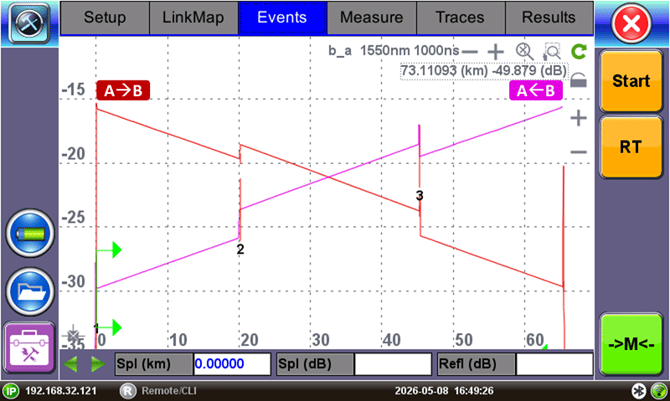
Figure 4. Bidirectional OTDR trace view (also known as the "X-View").
The true loss of a gainer event is obtained by averaging the loss values measured from the bidirectional OTDR traces (A→B and B→A). Since a gainer occurs when the OTDR test pulses transition from a lower‑backscatter fiber to a higher‑backscatter fiber, averaging the event's “gain” in one direction with the corresponding “loss” in the opposite direction cancels out the backscatter imbalance and yields the actual splice or connector loss.
If the trace indicates a dissimilar fiber segment and all you need to know is the total loss contribution for that specific section (including both splices), you can measure it from a single end using an OTDR. Apply the 4‑point loss calculation method by placing the two marker pairs immediately before and after the affected fiber segment—one just before the gainer and the other right after the high‑loss event.
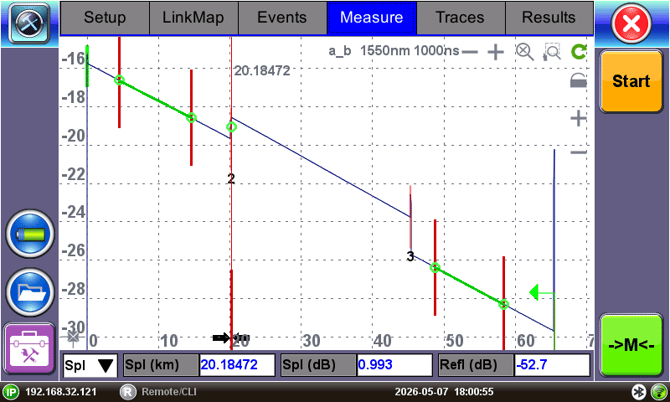
Figure 5. Measuring the total segment loss using the 4-point method.
If you are only interested in the total link loss, one alternative is to use an OLTS (optical loss test set) pair to measure the effective loss for the whole link. However, this end-to-end test requires one technician at each end of the link and, unfortunately, it doesn't provide details on individual events.
Takeaway
The key is to understand and recognize what causes gainer events, know how to measure them correctly, and then apply common sense to determine whether they are acceptable (expected) characteristics of the link under test or undesirable (unexpected) impairments that must be corrected.
Related Test Solutions
- FX160 FiberBEAST™ - Bidirectional OLTS and OTDR for FTTx/PON and Point-to-Point
- FX150+ - Handheld Mini OTDR for Point-to-Point and FTTx/PON
- RXT-4100+ - OTDR Test Module for RXT-1200/1202 test platform
- RXT-4113+ - xWDM OTDR Module Series for RXT-1200/1202 test platform
- Fiberizer® - Fiber Optics Test Data Management Platforms