
Hollow-Core Fiber: From Research to Reality
The relentless increase of Internet traffic and AI workloads keep pushing networks to carry more data and to do it with less delay. Hollow‑core fiber (HCF) is a newer type of fiber that has been researched for more than 20 years and is now becoming practical for limited deployment. Its key difference - it guides light mostly through air instead of solid glass, which can reduce signal delay (latency) and avoid some limitations of today’s standard telecom fiber.
Understanding Hollow-Core Fiber
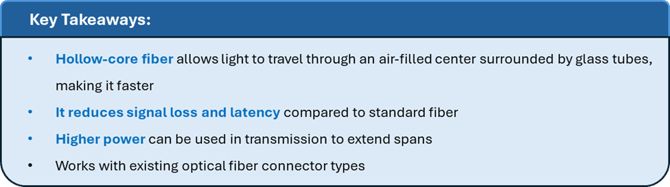
Hollow-core fiber is a new type of optical fiber where light travels through an air-filled center instead of a solid glass core. This makes it faster and more efficient for many applications.
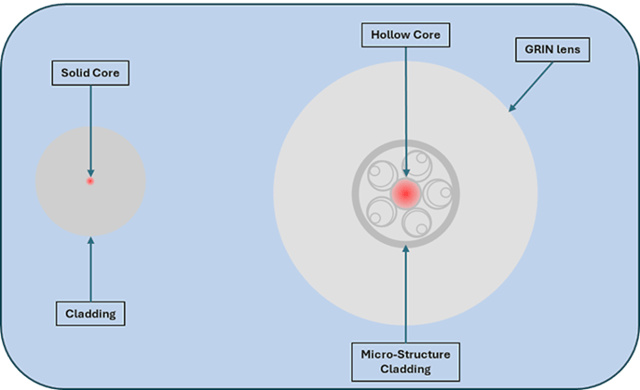
Solid core single mode fiber (SSMF)is the most widely deployed type of fiber in the communications industry. Light travels slower through this core because glass is denser than air slowing down light.
Most networks today use ITU‑T G.652D type fiber. In this fiber, light travels inside a solid glass core and is kept there by the way the glass is structured (the core “holds” the light so it stays on path). Because the light is moving through glass—not air—it travels more slowly, and tiny imperfections in the glass contribute to signal loss over distance.
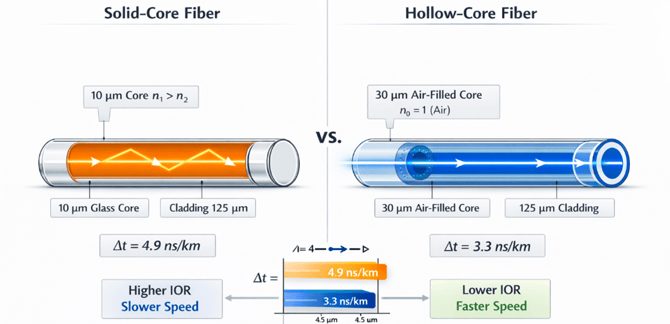
Hollow‑core fiber is an optical fiber where light travels mostly through an air‑filled center. A carefully designed glass structure around that hollow center acts like a “guide,” keeping the light confined to the middle even though the middle is not solid glass.
- Because light travels faster in air than in glass, HCF can deliver significantly lower latency (less delay).
- The surrounding glass structure (often described as “tubes”) helps keep the light on the intended path and helps filter out unwanted propagation patterns that can hurt signal quality.
- Because the light interacts much less with glass, several loss/noise mechanisms common in solid‑core fiber are dramatically reduced.
- HCF also reduces “nonlinear” effects that can limit performance in long or high‑power links, which can help support very clean signals and (in some designs) higher launched power.
- In practice, HCF is often sold pre‑terminated with specialized connectors, and can be adapted to commonly used connector types (such as LC, SC, or FC). Typical connector reflectance depends on the design.
Typical HCF Applications and Benefits
High‑power laser pulse delivery: Carrying very intense, very short laser pulses without the pulse getting “smeared” or changing shape as it travels through the fiber.
Low‑latency data links: Sending data with less delay by taking advantage of the fact that light travels faster in air than in glass—useful for time‑sensitive connections.
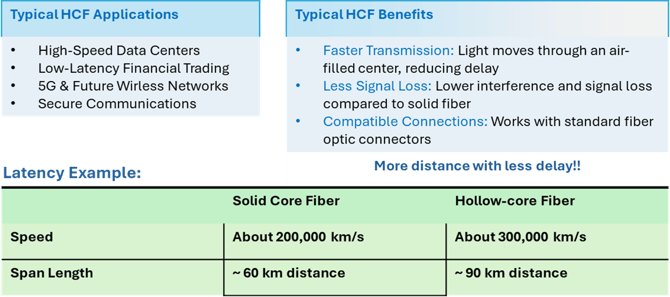
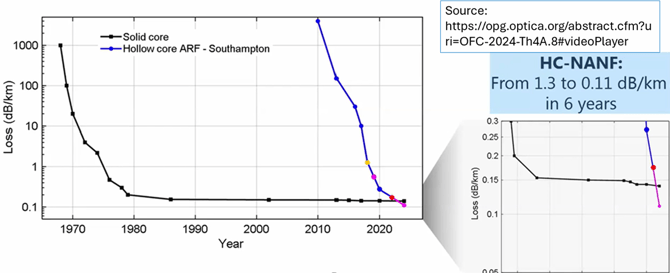
Low loss: HCF loss is 50% less than typical SSMF, consistently able to meet 0.11 dB/km and some tests has reported low as 0.03 dB/km loss.
How is Light Kept Inside a Hollow‑Core?
You’ll sometimes see HCF described by how its surrounding glass structure keeps light in the hollow center. Early versions of HCF had too much signal loss to be practical for data networks. Over time, better designs and manufacturing lowered the loss and improved how well the fiber guides light. The main families are photonic bandgap, Bragg, and anti‑resonant designs. For communications, anti‑resonant designs (often called AR, including NANF variants) are currently the most promising because they combine low loss with wide usable bandwidth.
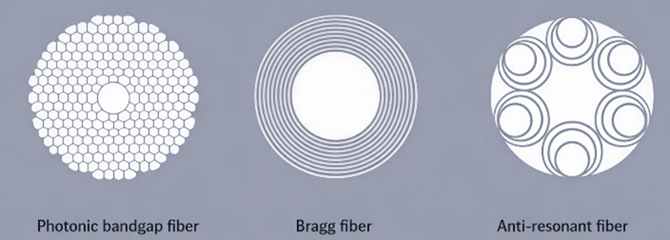
In simple terms, the surrounding structure (cladding) acts like a light “fence,” keeping the signal in the air‑filled core so it stays efficient and fast. Any higher order mode light signal is stripped by the surrounding structure. That’s the reason HCF can deliver roughly 30% lower latency than traditional solid‑core fiber over the same distance.
- Photonic Bandgap Fiber (PBG or HC-PBGF): Uses a very regular micro‑pattern (honeycomb) in the glass around the core to “block” light from leaking out, so it stays in the hollow center. These fibers can perform well, but the lowest‑loss operation is typically limited to a narrower wavelength window.
- Typical trade‑off: Strong guidance, but often a more limited “sweet spot” where performance is best.
- Bragg Fiber: A related approach that uses concentric layers (like rings) to form a reflective “mirror” around the core. It can guide light well but is complex to manufacture and is usually best over a limited wavelength range.
- Anti‑resonant Fiber (AR or ARF): Uses a simpler set of thin glass tubes around the core to keep light confined. This family has become the leading option for communications because it can offer low loss and a wide usable bandwidth.
- Why it matters: Broader operating windows and less interaction with glass, which supports cleaner signals and can reduce delay.
- Common AR variants: Several AR geometries are used in practice, including single‑ring and “nested” configurations. The leading candidate for communications today is NANF (nested anti‑resonant nodeless fiber), engineered to further suppress leakage and reduce loss. By adding extra tubes in nested or double‑nested nodeless anti‑resonant fibers (NANF and DNANF), designers can shift the resonant (transparency) wavelengths of each tube, effectively broadening the overall low‑loss bandwidth.
Although the photonic‑bandgap designs were used in the early days, recent progress in anti‑resonant designs (especially NANF‑type fibers) has delivered a more practical mix of low loss, wide bandwidth, and manufacturability. Since 2024, the communications industry focus had shifted toward AR/NANF‑style HCF for mainstream data transmission. The PBG‑style fibers continue to be used in specialized use cases.
All About Reduced Latency
In networking, latency is simply the time it takes for data to travel from point A to point B. Because light travels faster in air than in glass, HCF can reduce latency by about 30% versus standard solid‑core fiber. One practical impact is that two data centers can be placed farther apart while still meeting a tight “time budget” for applications that care about delay. For example, if a link budget or application constraint effectively limits solid‑core fiber interconnects to around 60 km, a similar time budget could allow roughly 90 km using HCF (numbers vary by design and system overhead). HCF’s lower interaction with glass can also reduce certain loss and distortion mechanisms, which may help extend reach before regeneration in some scenarios.
Key Differences Between HCF and SSMF.
|
Feature |
Hollow‑Core Fiber (HCF) |
Solid Single-Mode Fiber (SSMF) |
|
Core type |
Air‑filled (or gas) hollow core with micro-structured cladding |
Solid silica core |
|
Core size |
32-34 µm typical |
8-10 µm typical |
|
Light speed |
Faster: in air the refractive index is ~1.0003, so light travels at ~99.97% of its vacuum speed (~299,700 km/s) |
Slower: in typical telecom glass (e.g., G.652D with refractive index ~1.467), light travels at roughly ~68% of its vacuum speed |
|
Latency |
~ 3.3 to 3.5 µs/km ~30% lower latency than solid‑core fiber |
~ 5 µs/km (varies by Glass Manufacturing and type) |
|
Attenuation |
< 0.1 dB/km typ. @1550 nm; 0.03 dB/km reported |
~0.18–0.22 dB/km at 1550 nm |
|
Nonlinear effects |
Extremely low (light mostly in air) |
Present (Kerr, Raman, Brillouin) |
|
Scattering |
Very low Rayleigh/Raman/Brillouin; HCF Rayleigh scatter is 15-40 dB lower than SSMF (vendor dependent) |
Normal silica scattering mechanisms |
|
Bend sensitivity |
Higher; designing to reduce core size |
Very robust and standardized A2/B2/B1 |
|
Compatibility |
Careful splicing, mode‑field matching |
Fully standardized, easy to splice |
|
Use cases |
Ultra‑low‑latency links, sensing, high‑power delivery ~+37 dBm, advanced research |
Telecom, ISP networks, DWDM, FTTx, data centers |