
RXT-1200 and TX300S Platforms
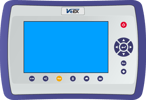

The RXT-1200 and TX300s platforms offer a useful Standby Mode (Sleep Mode), that shuts down all its hardware functions, except for the internal Atomic Clock (optional) and keeps the main CPU in sleep (low power) mode. It provides two main benefits:
- Very low power consumption during transit between jobs.
- Fast boot-up: <5 seconds.
- Keeps the Atomic Clock fully powered and operational, retaining time sync in holdover mode. (The test set's Atomic Clock will wake up in holdover mode.)
To activate the Standby Mode, simultaneously press the  HOME +
  ESC buttons simultaneously, until a tone (beep) is heard. The Power LED will remain Green to indicate the test set is still "ON".
During Standby, press the  HOME button to check the status of the test set's battery capacity, estimated battery autonomy in sleep mode, and the total time elapsed since it was put to sleep. Total time is important when using the Atomic Clock in holdover mode, since the longer the unit is kept in standby, the more the time sync would drift (inaccuracy uncertainty increases).
Press HOME +  ESC again, to bring the instrument back to full operational mode, then launch the test application(s) and run the necessary tests.
Note: For Atomic 1PPS reference clock applications, it is recommended to keep the Atomic Clock in holdover mode after waking up. If the GNSS receiver is manually reengaged after the test set returns from sleep, the Atomic Clock will initiate a new disciplining retraining cycle. While this might seem beneficial initially, the GNSS will generate a relatively inaccurate 1PPS signal immediately after its first lock. This signal will be used to retrain the Atomic Clock and may cause significant timing errors. The GNSS 1PPS output will become more accurate after completing the new site survey process, but by then the Atomic Clock's timing may have already been adversely affected.
In general, reference clocks in holdover mode are not recommended for precision timing or synchronization measurements on the field, since their frequency and phase (TE) drifts are unpredictable (unknown) and they increase over time.
V90-series Platforms

Smaller handhelds, such as the PX90, WX90, MTX90, FX92, and PX92 offer a programmable power saving mode. Users can swipe down from the top, to reveal the Main Menu, tap on  Settings and set Auto Sleep to the desired inactivity duration.
After the selected period of inactivity has passed, the test set enters into sleep mode (standby), turning the screens off, disconnecting from LAN/Wi-Fi and turning all ports off. The power LED will stay blinking to indicate that the test set is in sleep mode.
To quickly wake the test set up you can either press the Power button or double tap on the screen.