
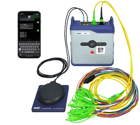
 The patent pending Optical Test Toolkit (OTT) is not recommended for switching visible light sources (VFL – Visual Fault Locator), because it is designed for single-mode (SM) optical signals in the 1260 to 1650 nm infrared range. The OTT's optical switch performance has not been specifically qualified for the out‑of‑range 630 to 670 nm visible red light generated by VFLs. Its insertion loss at those wavelengths is expected to be very high, resulting on a dim output. Typical VFL sources are Class II or IIa, below 1 mW, which are safe to use but, after passing through the switch, it may not deliver enough light energy for any practical visual fiber identification, continuity or polarity verification applications.
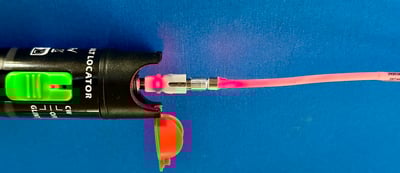
VeEX does not publish or guarantee any official insertion loss value for 650 nm, not only because this is outside the OTT's intended applications and specifications range, but because the overall system loss would also depend on several external factors. For instance, with high-power red lasers, there are significant light losses due to poor patch cord connector mating at the VFL’s non-locking universal 2.5 mm interface as well as along the fiber, causing significant amounts of light energy to leak (as illustrated below), introducing an indeterminate amount of loss, before even getting to and passing through the OTT's optical switch.
Some may still argue that using very high‑power VFLs (>10 mW) to substantially boost the 650 nm signal could offset the external losses, the OTT’s high internal insertion loss, and still achieve a practical range of a few kilometers or miles—enough for visual identification of individual fiber strands (for example, fiber drops). Technically, that is possible, however, this kind of “brute‑force” approach for Visual Optical Fiber Identification applications introduces several important issues that must be considered:
-
Restrictions: Global and local safety regulations, as well as company policies, regarding the use of high-power laser sources.
-
Although they can be easily sourced from online marketplaces, certain high-power VFLs may be considered illegal in your country/region.
-
Unreliable coupling between the VFL and single-mode (APC or UPC) patch cord connector, since their universal 2.5 mm adapters don't provide any locking mechanism or guaranteed contact.
-
Although some vendors may claim "optimized optical energy transfer to SM fibers", the VFL's laser is a multi-mode (MM) source.
-
Depending on the quality of the VFL torch manufacturer, it may or may not have a lens to properly focus most of its light onto the SM fiber core at the end face of the patch cord's connector, to transfer the maximum amount of energy from the source into the single-mode fiber cable.
-
Trusted manufacturers and brands may not offer VFLs with output powers above 10 mW. High‑power VFLs sourced from online marketplaces or grey/black markets often lack essential safety features, warning labels, or proper certifications, creating significant liability. Always select well‑known brands and purchase through trusted, authorized suppliers.
-
The energy lost (attenuation) inside the optical switch has to go somewhere and bright red photons have 2.4x more energy than infrared ones. Damage or deterioration to the OTT resulting from the use of very high‑power light sources may not be covered under the product's warranty.
 For safety reasons, local regulations may prohibit, restrict, or otherwise regulate the use of high‑power laser sources (for example, by requiring beam shutters, special switches, locks, keys, or mating sensors that prevent the unit from being turned ON accidentally). Regulations may also require users and bystanders to wear protective eyewear (goggles) that block the specific wavelength range of the laser being used. Always verify and follow your company’s policy regarding the use of high‑power laser sources.
Class IIIa (or 3R) lasers, with power outputs of 1–5 mW, pose risks of temporary flash blindness and potential permanent retinal damage if viewed directly or with optical aids.
Class IIIb lasers (5–500 mW) are hazardous to the eyes from direct, specular (mirror-like), and sometimes diffuse reflections, and at the higher levels they can cause skin burns. They pose a significant, immediate injury risk if viewed directly. Safety requires wearing appropriate protective eyewear, implementing interlocks, and using beam enclosures.
SAFETY NOTICE: The information in this article is provided for general educational purposes only and must not be used as a replacement for guidance from a qualified and trained Laser Safety Officer (LSO), whose duties and responsibilities are defined by OSHA and ANSI Z136 standards (USA).
Contact us for more information or visit:
-
OTT - Optical Test Tool (product page)
-
OTT Quick Reference Guide (customer-specific example)